A fair offer is the one a seller can accept without wincing and you can pay without regret. That sounds vague. It isn't, once you have a framework. Below is the one we use at Foundry, with actual percentages, a table by price band and two worked examples, a $180 jacket and a $1,200 bag, so you can see the thinking rather than just the answer.
First, the disclaimer that matters. These percentages are Foundry's rule of thumb. They are not eBay rules and no seller is bound by them. They are simply where offers tend to land well, based on how vintage sells.
Start with the evidence: sold listings
Asking prices are opinions. Sold prices are facts. Before you pick a number, search for the piece on eBay and switch on the Sold items filter. Now you're looking at what people actually paid.
- Match brand, era, type and condition as closely as you can. A 1990s wool blazer is not a 2010s one.
- Note size. Common sizes sell faster and closer to ask.
- Look at three to five sales, not one. One sale is an anecdote.
If sold comparables cluster near the asking price, the listing is well priced and your room is small. If they sit well below, you have a case, and you can quote it in a message.
The price bands
Price changes the maths. On cheap pieces a percentage is a few dollars and sellers have thin margins. On mid-range pieces there's usually more give. On high-ticket pieces a small percentage is already a serious sum. Here's where we'd start for a typical, well-presented piece with average interest.
| Price band | Typical fair offer | Example |
|---|---|---|
| Under $150 | 5-15% under ask | $95 knit: offer $81-90 |
| $150 to $500 | 10-20% under ask | $180 jacket: offer $144-162 |
| $500 to $1,500 | 10-20% under ask | $1,200 bag: offer $960-1,080 |
| Over $1,500 | 5-15% under ask | $2,400 coat: offer $2,040-2,280 |
Now adjust for the listing
The band is a starting point. Then the listing itself moves the number.
- Fresh listing or rare piece. Tighten to 5-10% under. A seller who listed a sought-after label three days ago has no reason to rush.
- Typical, well-priced piece. Stay in the 10-20% range.
- Listed a long time, 60 days or more, or lots of watchers and no sale. Widen to 20-30% under. The market has been telling the seller something.
- More than about 35-40% under. Lowball territory. Expect an auto-decline. Our post on lowball offers covers why.
Then two more things. Condition first. If flaws are disclosed and the price already reflects them, don't charge the seller twice. If a flaw is visible in the photos but not mentioned, that's legitimate room, and you should say so. Shipping second. Always think in total cost. A $150 dress with $30 shipping is a $180 dress.
Worked example: the $180 jacket
A 1980s Italian wool blazer, the kind you'd find in our designer coats and jackets. Asking $180 plus $15 shipping. You've been watching it for about 75 days. It shows 11 watchers. Photo seven shows a small moth nick on the left cuff that the description doesn't mention.
- Price band: $150 to $500, so 10-20% under. That's $144-162.
- Listing age and watchers: 75 days with 11 watchers and no sale. Widen to 20-30%. That's $126-144.
- Sold comparables: three similar blazers sold for $140-170.
- Condition: an undisclosed nick. Fair to mention.
The age says go low, the comps say not too low. Land at $145. That's about 19% under, sits inside what similar pieces sold for, and is well clear of lowball territory. Total cost with shipping, $160. Send it with a short note about the cuff and the comps. If the seller counters at $165, you're close. Counter at $155 or accept, depending on how much you want it.
Worked example: the $1,200 bag
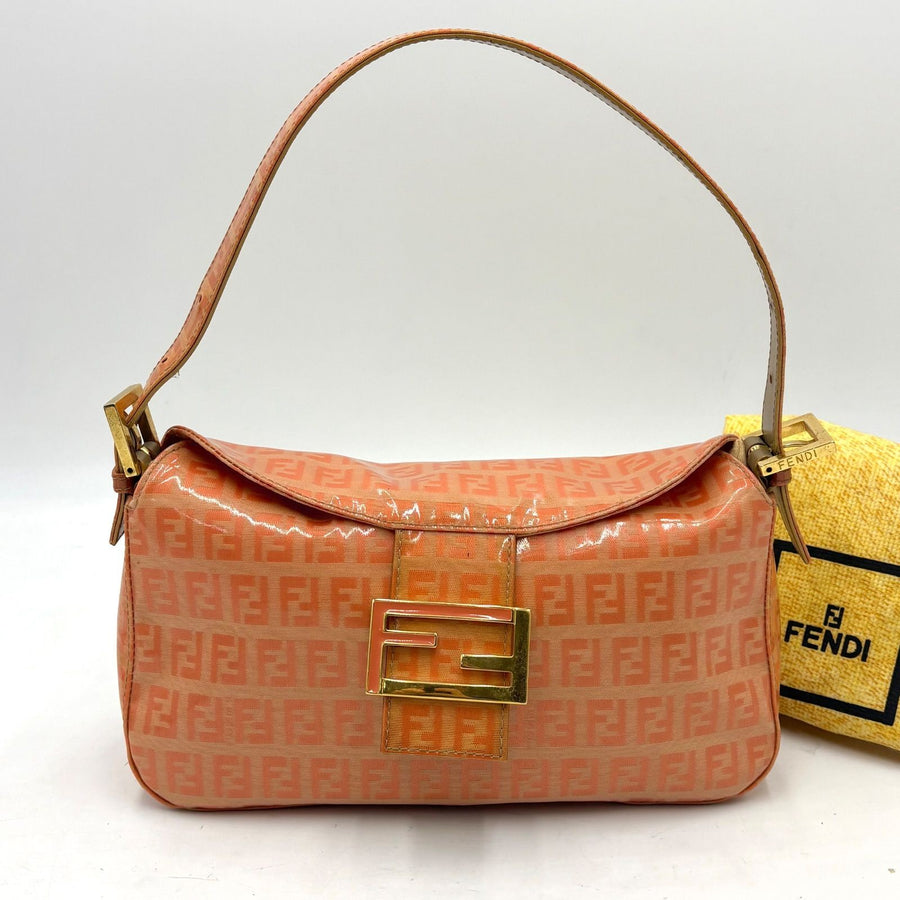
A 1990s bamboo-handle bag from a major house, the sort of thing in our luxury vintage handbags. Asking $1,200 with free shipping. Listed ten days ago. Three watchers. Light corner wear, clearly disclosed and photographed. Sold comparables in similar condition went for $1,050-1,350.
- Price band: $500 to $1,500, so 10-20% under. That's $960-1,080.
- Listing age: fresh. Tighten to 5-10%. That's $1,080-1,140.
- Comparables: the ask sits in the middle of recent sales. No case for a big discount.
- Condition: flaws disclosed and presumably priced in. No double-dipping.
Offer $1,100. It's about 8% under, respectful, and a real saving of $100. Offering $900 here would be 25% under on a ten-day-old listing priced in line with the market. That reads as fishing and risks an auto-decline. If the same bag were still sitting there at 90 days, $900-960 would become a perfectly fair conversation.
For smaller budgets the same logic applies. Our designer vintage bags under $400 sit mostly in the second band, where 10-20% is the usual sweet spot.
Frequently asked questions
What percentage should I offer below asking on eBay?
Our rule of thumb is 10-20% under for a typical well-priced piece, 5-10% on fresh or rare listings and 20-30% on pieces listed 60 days or more. These are Foundry guidelines, not eBay rules.
Does shipping count when I make an offer?
Your offer is on the item price. But judge your offer against the total cost, including shipping, because that's what you pay.
How do I check what a vintage piece is worth?
Use eBay's Sold items filter and compare three to five close matches on brand, era, condition and size.
Is a round number better than a precise one?
Either works. What matters more is that the number sits in a sensible range and, if it's on the low side, comes with a reason.
A fair offer is really a well-argued one. Know the band, read the listing, check the sold prices, count the shipping. Then send a number you'd be happy to see accepted, because it might be, instantly.
Next in the series: How eBay Best Offer Works: A Vintage Shopper's Guide. Lowball Offers on eBay: What Happens and Why They Fail. eBay Counteroffers, Timing and Messaging Sellers.