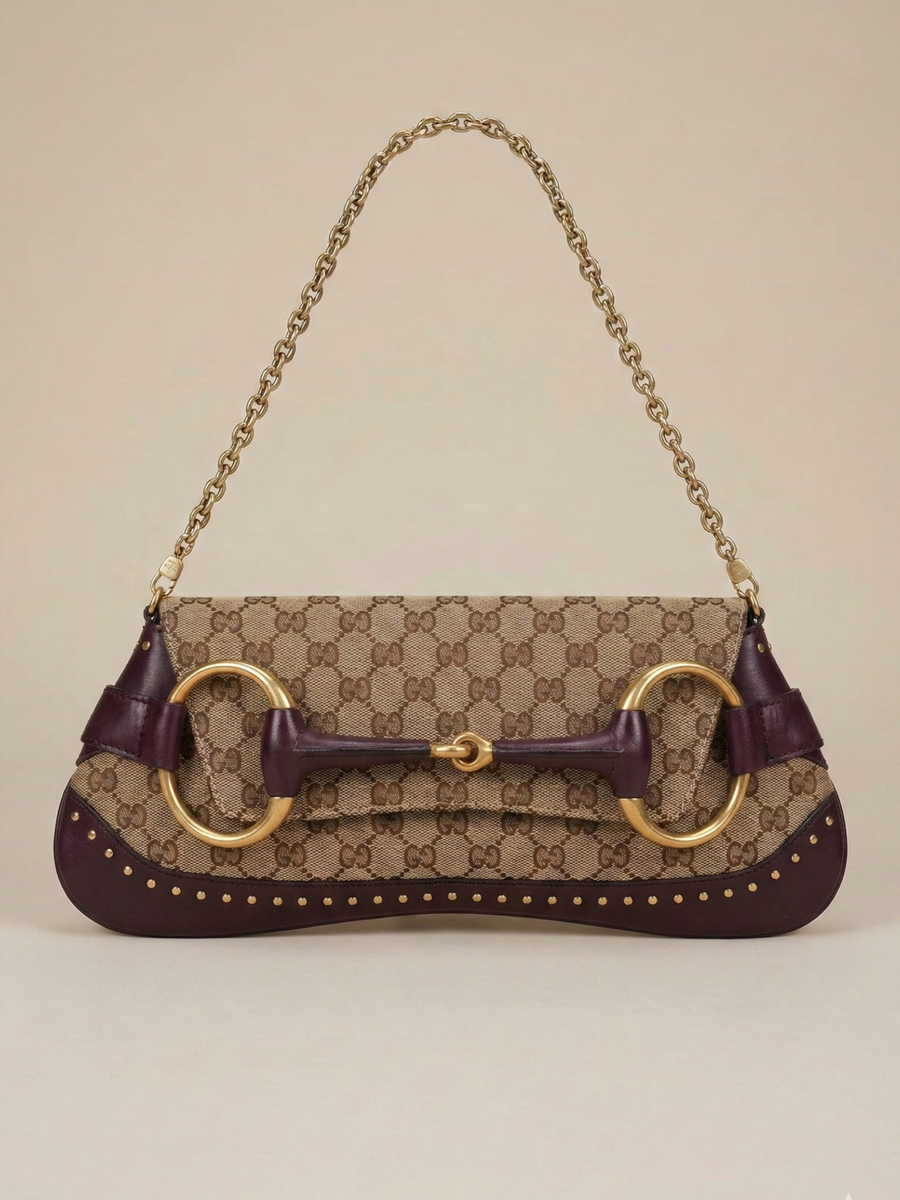
Ask any vintage dealer to name the single decade that changed luxury fashion forever, and most will point to the same nine years: 1994 to 2004, the period Tom Ford spent as creative director of Gucci. It's the era that took a stalling, family-feuded Italian leather house on the edge of bankruptcy and turned it into the most talked-about brand on the planet — and it's the era that, three decades later, still defines what "modern Gucci" means in the resale market. At Foundry, Tom Ford–era Gucci is among the most consistently requested categories we source for, and it's also one of the most misunderstood: plenty of pieces get marketed as "Tom Ford Gucci" that are actually Frida Giannini-era reissues or Alessandro Michele homages borrowing the same iconography. This guide breaks down what the era actually was, what made the clothes and accessories different at a construction level, and how to tell the real thing from the imitations that followed it.
Gucci Before Tom Ford: A House in Crisis
It's easy to forget, looking at Gucci's current cultural dominance, that the brand nearly didn't survive the early 1990s. Founded in Florence in 1921, Gucci had spent the 1980s consumed by an infamous family feud between Aldo Gucci and his nephew Maurizio, watered-down licensing deals that put the double-G logo on everything from luggage to whiskey, and a reputation that had drifted from "Italian luxury leather goods house" to "airport gift shop." Maurizio Gucci sold his remaining stake to Investcorp in 1993, and the company brought in Domenico De Sole as CEO and a young Texan named Tom Ford — who had joined as a ready-to-wear designer in 1990 — as creative director in 1994. The house was, by most accounts, close to insolvent. What happened over the next decade is now a business-school case study.
What Tom Ford Actually Changed
Ford's first full womenswear collection under his own creative direction, shown for Spring/Summer 1995, is still referenced in fashion history as one of the most consequential runway moments of the decade — hip-slung velvet trousers, sheer metal-mesh tops, and a sexuality that felt controlled and expensive rather than crude. It became known, somewhat reductively, as the "wet look" or "porno chic" collection, and it put Gucci back on the cultural map overnight. Ford pulled the brand's own archive forward: the equestrian horsebit hardware and bamboo details Aldo Gucci had introduced decades earlier, the GG monogram canvas, and the Jackie shoulder bag (worn by Jackie Kennedy in the 1960s and renamed the "New Jackie" under Ford) were all reintroduced with sharper, more minimal execution. He also brought in genuinely rigorous tailoring — Ford trained under Cathy Hardwick and Perry Ellis before Gucci, and it shows in the precision of the era's pantsuits and shirting.
By the late 1990s, Gucci under Ford was one of the fastest-growing luxury businesses in the world, and the pieces from this window — square-toe horsebit loafers, low-rise "bumster"-adjacent trousers, the G-string thong sandal, velvet hipsters, the reissued 1955 Horsebit bag — had become genuine cultural signifiers. Madonna, Gwyneth Paltrow (in that green silk shirt at the 1996 VMAs), and Mrs. Presley regulars all wore it. Gucci Group went public in 1995, survived a hostile takeover attempt from LVMH in 1999 by selling a controlling stake to PPR (now Kering), and by 2003, Ford and De Sole had built the group into a multi-brand luxury conglomerate that also owned Yves Saint Laurent, Bottega Veneta, and Balenciaga. Ford and De Sole both left Gucci in 2004 after disagreements with PPR over creative control — a clean, hard end date that's exactly why "the Tom Ford era" is such a precisely definable category for collectors.
What Actually Defines a Tom Ford–Era Piece
If you're shopping vintage and want the real thing rather than a later piece riffing on the same codes, here's what to look for.
- Minimal, deliberate hardware. The horsebit snaffle and bamboo ring hardware from this era is bright, evenly plated brass with crisp, shallow engraving — never oversized or piled on. Ford used it as a single accent, not a repeated pattern.
- Restrained GG canvas. The interlocking-G monogram canvas from 1994–2004 runs in a tighter, more muted colorway — typically beige/ebony with dark brown leather trim — rather than the brighter, higher-contrast prints Gucci used in the 1970s or the oversized prints of later revivals.
- Two-part serial number tabs. Bags and small leather goods from this window carry a leather tab inside the interior pocket stamped with a 10-digit style/model number on the top line and a 6-digit color code beneath it. The stamping should be crisp and slightly recessed into the leather, not printed flat on the surface.
- Precision tailoring. Jackets and trousers from the era use fully canvassed construction on tailored pieces, clean single-needle stitching, and horn or metal buttons stamped with the Gucci name — not plastic.
- Restrained branding. Ford deliberately pulled back on visible logo placement compared to both the 1970s Gucci and the Michele-era Gucci that came decades later. If a piece is covered edge-to-edge in logo, it's very likely not from this window.
Gucci's Eras at a Glance
| Era | Creative Direction | Aesthetic | What to Look For | Typical Resale Range* |
|---|---|---|---|---|
| 1960s–1970s | Aldo Gucci | Equestrian heritage, Flora print, bamboo handles | Textured jacquard GG canvas, natural bamboo hardware | $300–$2,500 |
| 1994–2004 | Tom Ford | Minimal sensuality, sharp tailoring, revived horsebit | Two-line serial tabs, restrained hardware, muted GG canvas | $400–$4,000+ |
| 2005–2014 | Frida Giannini | Bohemian glamour, bamboo revival, bright GG print | Higher-contrast monogram, more visible branding | $250–$2,000 |
| 2015–2022 | Alessandro Michele | Maximalist, eclectic, vintage-referencing | Mixed prints, exaggerated logos, ornate hardware | $300–$3,000 |
*Ranges reflect general secondhand market observations for handbags and small leather goods in good to excellent condition; individual pieces vary by rarity, material, and condition grade.
Why Vintage Tom Ford Gucci Still Sells
Fashion has spent the last several years circling back to exactly the aesthetic Ford pioneered — quiet luxury, sharp tailoring, minimal branding, sensuality that reads as confidence rather than excess. Pieces designed thirty years ago slot into a 2026 wardrobe without looking dated, which is precisely why this category holds value on the resale market better than almost any other Gucci era. It also helps that the actual construction quality is high: full-grain leathers, real canvassing in tailored pieces, and hardware plated to last rather than to look shiny for one season.
What to Watch For When Buying
Because this era is so heavily referenced by later Gucci collections — and so heavily counterfeited — condition and documentation matter enormously. Check serial tab stamping depth and font consistency, inspect stitch density around hardware attachment points (counterfeits often use fewer, looser stitches), and look closely at leather grain on bamboo handles, which should show natural variation rather than uniform, synthetic-looking color. This is exactly the kind of detail work Foundry's team does before anything from this era gets listed — every piece is hand-condition-graded and checked against era-specific construction markers before it goes live, so you're not left guessing whether a "Tom Ford Gucci" listing is actually from 1994–2004 or just styled to look like it.
FAQ: Tom Ford–Era Gucci
What years count as the Tom Ford Gucci era?
Tom Ford joined Gucci as a ready-to-wear designer in 1990 and became creative director in 1994; his tenure as creative director ran through 2004, when he and CEO Domenico De Sole both departed. "Tom Ford era Gucci" almost always refers to pieces produced and shown between 1994 and 2004.
How can I tell Tom Ford–era Gucci from later Gucci?
Look at the serial tab format (two-line, 10-digit plus 6-digit code), hardware finish (restrained, evenly plated, not oversized), and GG canvas colorway (muted beige/ebony rather than bright or oversized prints). Later eras under Frida Giannini and Alessandro Michele reused Ford-era codes but with visibly different proportions and branding intensity.
Is vintage Tom Ford Gucci a good investment?
Handbags, footwear, and tailored pieces from this era have shown consistent resale demand because the aesthetic has aged well and the construction quality holds up. Rare runway pieces and iconic styles like the horsebit loafer, the 1955 Horsebit bag, and velvet tailoring tend to hold value best.
What's the price range for authentic pieces?
Small leather goods and accessories typically run $300–$1,200, handbags $600–$4,000+ depending on rarity and condition, and tailoring and runway pieces can go well beyond that for documented, exceptional examples.
Where should I buy vintage Tom Ford Gucci?
Buy from sellers who condition-grade and authenticate before listing, and who can speak specifically to era-dating markers like serial tab format and hardware finish rather than just "vintage Gucci" in the title.
Ready to shop the era that redefined Gucci? Browse Foundry's collection of authenticated Tom Ford–era Gucci, hand-selected and condition-graded piece by piece, alongside our full range of vintage Gucci, luxury vintage handbags, and Y2K-era designer fashion.