By Foundry’s curation team — the people who condition-grade and authenticate every vintage piece before it’s listed
Some design details never truly disappear — they wait for the right moment to feel relevant again. The Gucci horsebit is one of them. Originally cast for a pair of loafers in 1953, then adapted onto a bag in 1955, it has spent seven decades cycling in and out of the spotlight without ever actually going anywhere. Right now, it’s back in the spotlight — and for buyers trying to tell a real vintage piece from a reissue, or figure out whether it’s actually worth the money, the internet’s answers have mostly been vibes, not specifics.
This is the specific version. History, the exact models worth knowing, how to authenticate a vintage piece before you buy one, what things actually cost, and how it’s being worn today.
A Brief History of the Gucci Horsebit
The horsebit motif — two interlocking rings joined by a bar, lifted directly from equestrian bridle hardware — first appeared on Gucci loafers in 1953, a nod to the house’s origins as a maker of fine leather goods for the horseback-riding set. Two years later, in 1955, Gucci moved the hardware onto a bag for the first time: a structured shoulder bag in bridle leather, built with the same jewelry-grade casting used on the shoe hardware. That original 1955 Horsebit shoulder bag is the piece every subsequent version has been referencing ever since, including Gucci’s own recent reissues.

The motif went on to appear across decades and design eras, each with a distinct character:
-
1970s–80s structured horsebit bags. Heavier hardware, boxier silhouettes, thicker bridle or pebbled leather. These were built as investment pieces, not seasonal ones, and it shows in how they hold up.
-
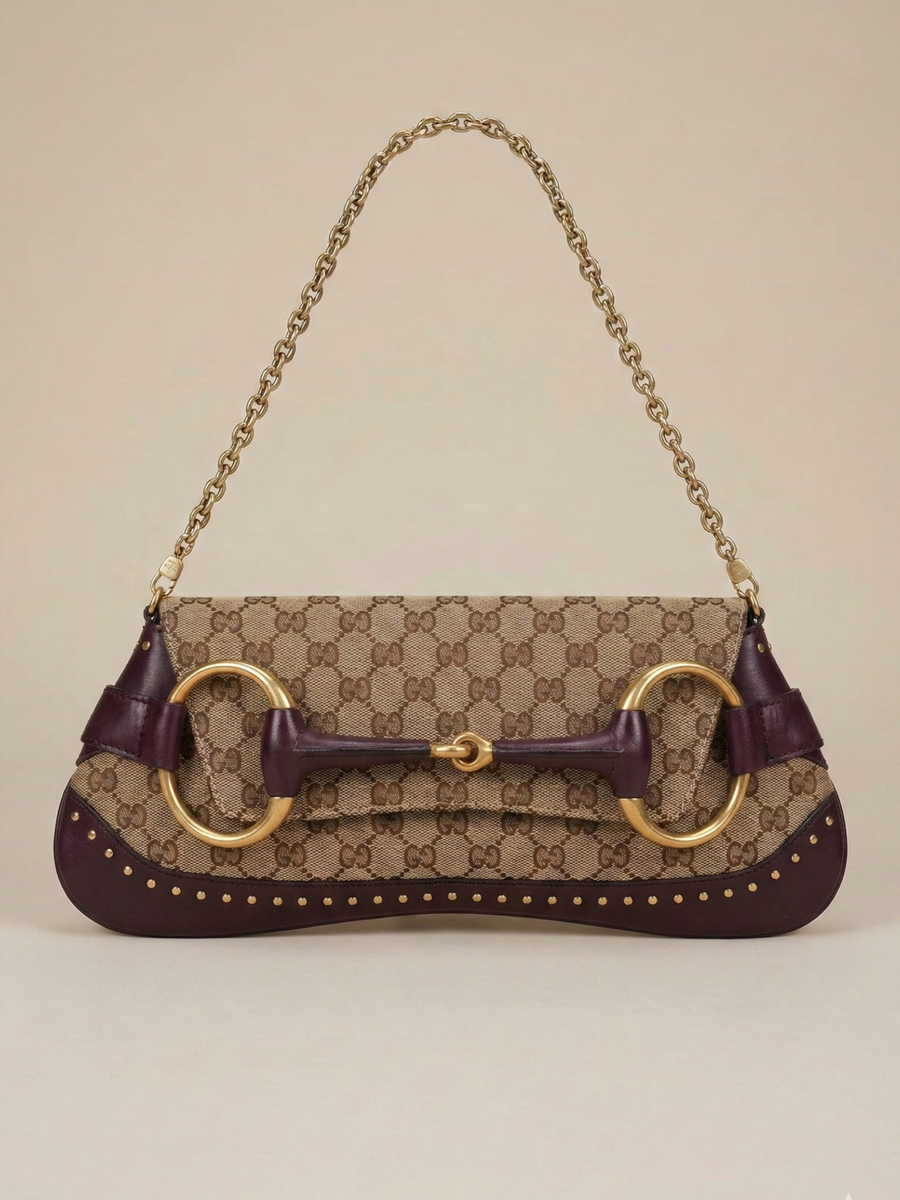
1994–2004: the Tom Ford era. Ford’s tenure reworked the horsebit into sleeker, often chain-strapped bags with a sharper, more minimal silhouette — part of the broader reinvention that made Gucci the label of the late ’90s. Foundry’s vintage Gucci collection regularly turns up pieces from exactly this window, and they’re some of the most requested.
-
2015–2020: the Alessandro Michele revival. Michele reintroduced the horsebit across bags, loafers, and belts as part of his maximalist, archive-referencing take on the house, reintroducing the detail to a generation that hadn’t necessarily clocked its 1955 origins.
-
2023 and onward: the current reissue line. Modern manufacturing, modern materials, and modern pricing — useful to understand specifically because it’s what most people are comparing a vintage piece against, often without realizing it.
Knowing which of these four eras you’re looking at isn’t trivia. It’s the difference between paying vintage-market pricing for a piece and paying reissue pricing for something described loosely as “vintage-inspired.”
Why the Horsebit Feels Relevant Again
Fashion’s current mood has shifted away from logo recognition and toward restraint — pieces that read as intentional rather than loud. The horsebit fits that shift almost too perfectly: it’s instantly recognizable to anyone who knows what they’re looking at, and essentially invisible to anyone who doesn’t. That’s a very specific kind of status signal, and it’s exactly the one currently in demand.
It also helps that the horsebit has never been a single-decade trend. A piece bought in 1978 and a piece bought in 2019 are both recognizably, correctly “the horsebit bag” — which is precisely why resale search interest for vintage horsebit pieces has been climbing steadily rather than spiking and fading the way a single-season logo trend does.
How to Identify a Real Vintage Gucci Horsebit Bag
This is the part most trend coverage skips, and it’s the part that actually matters if you’re about to spend real money. A handful of details separate a genuine vintage horsebit piece from a convincing reproduction — and, just as importantly, help you confirm which era you’re actually looking at.
Hardware. Vintage horsebit hardware is cast, not stamped — it has real weight and dimensional depth in the hand, with the two rings and center bar sitting slightly proud of the leather rather than looking pressed flat. The proportions of the ring-and-bar assembly have shifted subtly across decades, so hardware that looks slightly “off” for the era a seller claims is worth a second look, not a shrug.

Leather and stitching. Structured 1970s–80s pieces use thicker bridle or pebbled leather with tight, consistent stitching along the horsebit mount points, since that hardware carries real weight and shoddy stitching fails fast. Tom Ford-era pieces tend toward smoother, slightly softer leather in line with the era’s sleeker silhouettes. Reissue leather, by comparison, is usually noticeably softer and more uniform — evenly finished in a way that reads as new rather than aged.
Interior serial strip. Gucci’s interior serial numbering has changed format and placement more than once since the 1970s, so the strip should be consistent with the era the piece is claiming, not just present. A serial strip in the wrong format for the claimed decade is one of the fastest tells available.
Canvas GG pattern (fabric versions). On horsebit pieces built with monogram canvas rather than solid leather, the GG pattern generation and print register are era-specific and worth cross-checking against dated reference photos — canvas printing methods, like the hardware, evolved over time.
No single detail above should carry the whole decision. The way Foundry authenticates every piece before it’s listed is to look at all of them together — hardware weight, leather and stitching, serial strip, and (where relevant) canvas — because a genuine piece will agree with itself across every check, and a reproduction almost never does.
Horsebit Through the Decades
|
Era |
Model / Description |
Hardware & Material Tell |
Typical Vintage Resale Range Today |
|---|---|---|---|
|
1955 |
Original bridle-leather Horsebit shoulder bag |
Heavy cast hardware, structured bridle leather, earliest serial formats |
$800 – $2,200 (rare, collector-grade) |
|
1970s–80s |
Structured horsebit shoulder bags & totes |
Boxier silhouettes, thick bridle/pebbled leather, dense stitching at hardware mounts |
$400 – $900 |
|
1994–2004 |
Tom Ford-era horsebit chain bags |
Sleeker silhouette, smoother leather, chain-strap variants |
$600 – $1,400 |
|
2015–2020 |
Alessandro Michele revival pieces |
Maximalist detailing, mixed hardware finishes, archive-referencing shapes |
$500 – $1,100 |
|
2023+ |
Current reissue line (pre-owned) |
Modern uniform leather finish, contemporary hardware casting |
$900 – $1,800 |
Ranges reflect typical vintage and pre-owned resale market pricing by condition; individual pieces vary based on rarity, hardware finish, and documented provenance.
Vintage Horsebit Bags vs. Modern Reissues
Vintage and reissue horsebit bags are not interchangeable, even when they look similar in a listing photo. Vintage pieces were generally built with heavier, thicker leather and denser stitching — construction decisions made when a bag was expected to be a decade-plus purchase, not a seasonal one. Reissues prioritize consistency and lighter weight, which reads as polish in a boutique but as a different (and less durable) object once you’ve handled both side by side.
Real vs. Reissue: Quick ID Checklist
|
Detail |
Vintage |
Modern Reissue |
|---|---|---|
|
Hardware weight |
Heavy, cast, dimensional |
Lighter, more uniform casting |
|
Leather texture |
Thicker, more character, ages with visible patina |
Smoother, more uniform finish |
|
Stitch density |
Tighter, denser at hardware mounts |
Consistent but less pronounced |
|
Serial number format |
Era-specific interior strip |
Current-era formatting |
|
Typical price |
$400 – $2,200 depending on era/condition |
$1,890 – $4,500 new retail |
Unlike logo-heavy alternatives, horsebit purses don’t feel dated when trends shift — which is exactly why the vintage originals are worth seeking out on their own terms, not just as a cheaper alternative to buying new.

The Role of the Horsebit in Quiet Luxury
The horsebit’s current moment is really a symptom of a bigger shift: recognizable without being flashy, rooted in heritage rather than hype. That’s the entire quiet luxury proposition in one piece of hardware. Tom Ford’s horsebit-era Gucci designs in particular hit this note precisely — sleek enough to read as current, but carrying two decades of design pedigree that a brand-new bag simply can’t manufacture.
How to Style a Horsebit Purse Today
A horsebit bag functions best as a neutral anchor rather than the loudest thing in an outfit — it works with tailored outerwear, with relaxed denim, and with minimal evening pieces, letting everything else define the look. For evening styling specifically, a vintage horsebit clutch pulls the same trick at a smaller scale: recognizable to anyone who knows, invisible to anyone who doesn’t, and considerably easier to build a whole outfit around than a bag carrying an obvious logo.
Why Vintage Horsebit Bags Are Worth Seeking Out
Three things make a vintage piece worth the hunt over a new one: timeless design that hasn’t required a single reinvention to stay relevant, construction quality built for decades rather than seasons, and the fact that — unlike a logo bag frozen in the year it was purchased — a horsebit bag has never actually gone out of style long enough to date itself.
Foundry’s Perspective on the Horsebit Revival
The horsebit’s return isn’t a comeback so much as a correction — proof that the fashion cycle has finally slowed down enough to appreciate a design that never needed the spotlight to justify itself. That’s the whole thesis behind how Foundry sources: not chasing whatever’s loudest this season, but finding the pieces built to matter regardless of season. Every vintage Gucci horsebit piece that comes through Foundry gets handled, condition-graded, and authenticated the same way — by someone who actually knows what they’re looking at, not a form.
Frequently Asked Questions
What is the Gucci horsebit? The horsebit is Gucci’s signature hardware motif — two interlocking rings joined by a bar, modeled on equestrian bridle hardware. It debuted on loafers in 1953 and moved onto handbags in 1955, and has appeared across the house’s designs in every decade since.
What years did Gucci make the horsebit bag? The original horsebit shoulder bag launched in 1955. Structured horsebit bags continued through the 1970s and ’80s; Tom Ford reworked the motif into sleeker chain bags from 1994–2004; Alessandro Michele revived it prominently from 2015–2020; and Gucci has produced a current reissue line since 2023.
How can you tell a vintage horsebit bag from a new one? Check hardware weight and casting detail, leather thickness and stitch density, and the interior serial number format against the era the piece is claimed to be from. Vintage hardware is heavier and more dimensional; reissue leather is smoother and more uniform. No single check is conclusive on its own — look for all of them to agree.
Are horsebit bags still in style? Yes — and unlike most single-season trends, the horsebit’s current popularity is really a continuation of seven decades of steady relevance rather than a new discovery. Its current alignment with the quiet luxury movement has brought it back into sharper focus, but it’s never fully left.
Is a Gucci horsebit bag a good investment? Vintage horsebit pieces, particularly structured 1970s–80s bags and Tom Ford-era chain bags, have held resale value well precisely because the design hasn’t needed reinvention. As with any vintage luxury purchase, condition and authentication matter more to long-term value than the era alone.
Ready to see what’s currently available? Browse this week’s Thursday drop for the latest vintage Gucci pieces Foundry has sourced and authenticated.