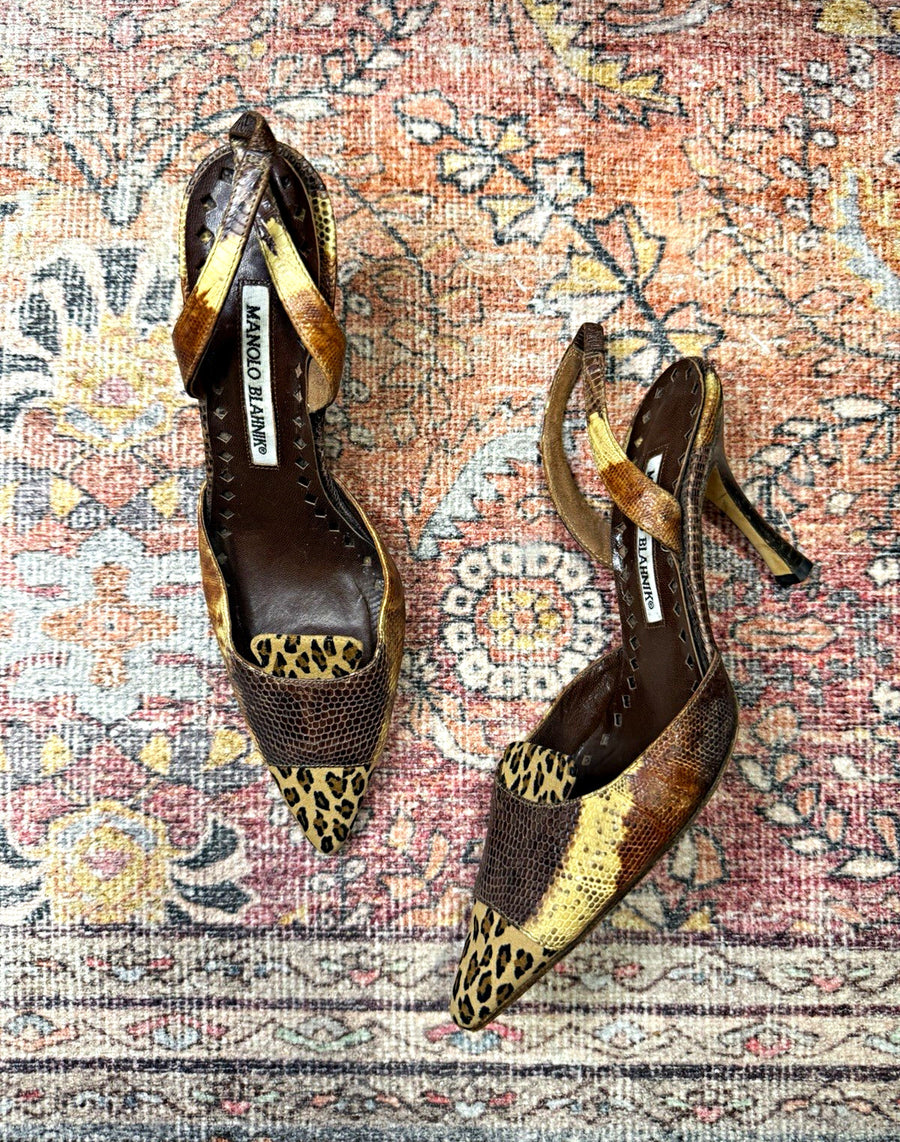
If you're shopping for vintage Manolo Blahnik shoes, you're likely weighing a real question: is it worth paying vintage-market prices for a decades-old pair when the brand still makes shoes today? For most buyers, the answer is yes — but only if you know what you're actually buying, what it should cost, and how Manolo's sizing quirks affect fit. This guide is built specifically for that purchase decision: what a fair price looks like by era, what to check on a listing before you buy, how sizing runs on this particular brand, and where to shop with confidence.
A Quick Primer on the Silhouettes You'll See For Sale
Manolo Blahnik's design language has stayed remarkably consistent since he founded the house in 1971, which is part of why vintage pairs still look current. A few silhouettes come up constantly in resale listings, and knowing them helps you search smarter.
- The BB pump — the brand's signature, a simple pointed-toe pump with a slim stiletto heel. It's been in continuous production in various forms since the '90s, so vintage BB pumps span multiple decades of leather and heel construction.
- Mary Janes — a recurring Blahnik shape since the '70s and '80s, often in unusual colorways and fabrications that haven't been repeated in current collections.
- The Hangisi — the jeweled buckle pump made famous by "Sex and the City" (2008), now a modern classic; true vintage examples are early-2000s and are increasingly hard to find under $1,000.
- Ankle-strap sandals — a strong category through the '80s and '90s, often in exotic or unusual leathers no longer used due to sourcing restrictions.
What Makes Vintage Manolos Worth Buying (Not Just Owning)
Three things drive resale value here, and they're the same three things you should be checking before you buy: leather quality, heel construction, and rarity of the specific style. Manolo Blahnik has historically used exceptional leather sourcing even on relatively simple silhouettes, and heels — especially on pre-2000s pairs — were built with a wooden or steel-reinforced core rather than the more common molded plastic core used industry-wide today. That's a meaningful durability difference, and it's part of why well-kept vintage pairs still wear beautifully decades later.

Authentication and Construction Checks Before You Buy
Manolo Blahnik is one of the more heavily counterfeited vintage designer shoe brands, so a few checks are worth doing on every listing before you commit.
| What to Check | What You Want to See |
|---|---|
| Insole stamping | "Manolo Blahnik" stamped in gold or silver foil, clean and evenly spaced — not printed or peeling |
| Heel construction | Solid, weighted heel with no hollow feel or visible seam lines where plastic components meet |
| Leather grain | Natural, slightly irregular grain on calfskin and suede; no plastic sheen |
| Stitching at the vamp | Tight, even stitching — Manolo's construction rarely shows loose threads or skipped stitches |
| Country of origin label | Historically made in Italy; the label should be consistent with the era and style |
This is exactly what our team checks before any pair goes live in the vintage Manolo Blahnik collection — insole stamping, heel integrity, and leather condition are each graded individually rather than summarized as one vague condition score.
Dating a Pair by Its Labeling
Roughly speaking, pre-1990s pairs tend to have simpler, smaller insole stamping and slightly heavier heel construction; 1990s–2000s pairs introduced more consistent foil stamping and the sizing conventions still used today; post-2010 pairs (once the brand changed ownership structure) show more standardized labeling and materials sourcing documentation.
Sizing Quirks Specific to Manolo Blahnik
This is where a lot of first-time vintage Manolo buyers get tripped up, and it's worth being specific about it.
- The brand runs notoriously narrow. Manolo Blahnik's last is famously slim through the toe box, more so than most comparable Italian luxury footwear. If you have a wider or higher-volume foot, size up rather than trusting your usual designer shoe size.
- Vintage pairs run even narrower than current stock. Pre-2000s lasts were cut slightly narrower still, before the brand made minor adjustments in later decades.
- European sizing has shifted slightly over time. A marked EU 37 from the 1980s can measure closer to a modern 36.5–37 — always check the measured insole length in a listing rather than relying on the marked size alone.
- Suede stretches, satin and leather do not. If you're between sizes, a suede pair has more forgiveness than a structured satin or smooth calfskin pair.

| Marked EU Size | Typical US Size | Fit Note |
|---|---|---|
| 36 | 6 | Narrow even by Manolo standards on pre-2000s pairs |
| 37 | 7 | Most common vintage resale size — verify insole length |
| 38 | 8 | True to size for most modern feet |
| 39 | 9 | Fits slightly narrow toe box; consider sizing up if wide-footed |
Where and How Much to Pay
Prices vary widely by silhouette, era, and condition, but here's a realistic range to shop against so you know when a listing is fairly priced.
| Style / Era | Typical Price Range |
|---|---|
| Classic BB pump, worn condition | $120–$250 |
| Classic BB pump, excellent condition | $250–$450 |
| Vintage Mary Jane or ankle-strap, 1980s–90s | $200–$450 |
| Early-2000s Hangisi pump | $700–$1,500+ |
| Rare exotic-leather styles | $400–$900+ |
Buy from sellers who photograph the insole stamping, heel base, and sole wear specifically — not just an angled product shot. If a listing only shows the shoe from one flattering angle, ask for more photos before buying.

Frequently Asked Questions
Where can I buy authentic vintage Manolo Blahnik shoes?
Reputable curated resale sites that individually authenticate and condition-grade each pair are the safest option, since they document insole stamping, heel construction, and leather condition before listing — far more reliable than unverified marketplace listings.
How much do vintage Manolo Blahnik shoes typically cost?
Classic BB pumps generally run $120–$450 depending on condition, while rarer styles like early Hangisi pumps or exotic-leather pairs can run $700–$1,500 or more.
Do Manolo Blahnik shoes run true to size?
No — the brand is known for a narrow last, and vintage pairs in particular run narrower than most comparable luxury footwear. If you're between sizes or have a wider foot, sizing up is usually the safer choice.
How can I tell if vintage Manolo Blahnik shoes are authentic?
Check the insole stamping (should be foil-stamped, not printed), heel construction (solid and weighted, no hollow feel), and leather grain (natural and irregular, not plastic-looking). Inconsistent or blurry stamping is the most common counterfeit tell.
Are vintage Manolo Blahnik shoes comfortable to wear regularly?
Well-maintained pairs with intact heel construction can absolutely be worn regularly, though the narrow last means fit matters more than usual — a pair that's slightly too narrow will be uncomfortable regardless of how well-preserved it is.
What's the difference between buying vintage Manolo Blahnik shoes and buying current-collection pairs?
Vintage pairs offer construction details (like wooden or steel-reinforced heel cores) and discontinued colorways or leathers not available in current collections, typically at a lower price than new — but require more careful condition and authenticity checks before purchase.
Shop our current edit of vintage Manolo Blahnik shoes, each pair authenticated and condition-graded by our curation team before it's listed, with insole stamping, heel integrity, and leather condition documented so you can buy with confidence.